

Omega-7: What It Is, Benefits, Sources & Why Sea Buckthorn Matters
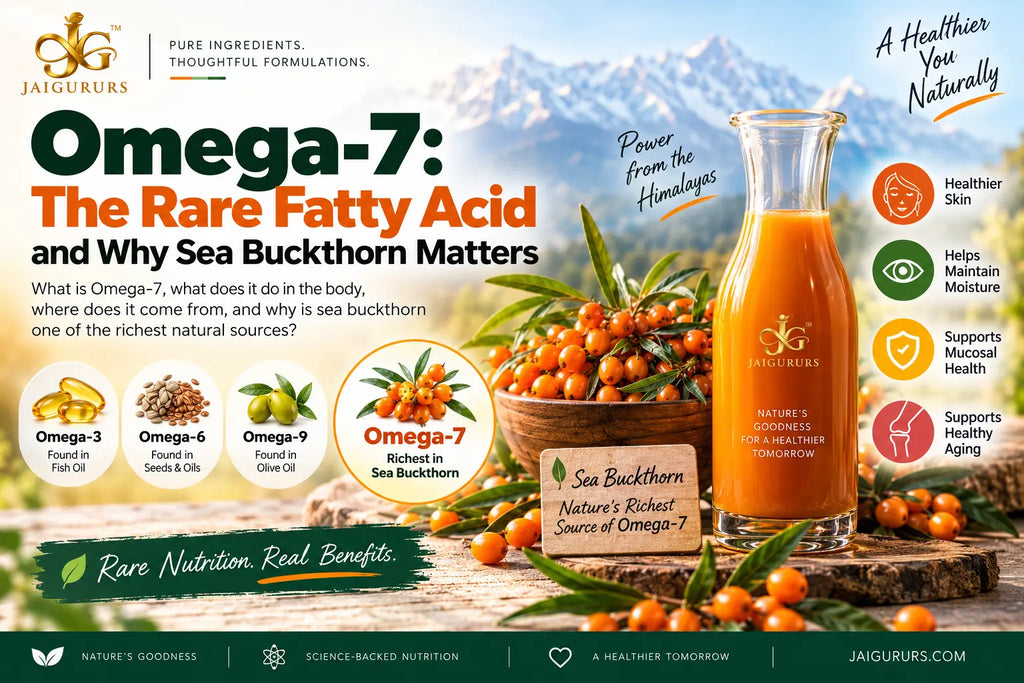
When people talk about healthy fats, Omega-3 and Omega-6 usually get most of the attention. A less familiar fatty acid, Omega-7, is also found in certain foods and plant oils. One of its best-known forms is palmitoleic acid (16:1 n-7), a monounsaturated fatty acid found in relatively few plant sources.
Sea buckthorn (Hippophae rhamnoides) is particularly interesting because its fruit and oils contain palmitoleic acid along with other fatty acids, carotenoids, tocopherols and other bioactive compounds. Reviews of sea buckthorn research identify palmitoleic acid as one of the characteristic fatty acids found in sea buckthorn oil. Research review
So what is Omega-7, what are its potential benefits, where can you find it, and why does sea buckthorn receive so much attention? This guide separates established nutrition facts from early or emerging research.
What Is Omega-7?
Omega-7 describes a family of monounsaturated fatty acids. The form most often discussed in nutrition research is palmitoleic acid, also written as 16:1 n-7.
Palmitoleic acid occurs naturally in the human body and in a range of foods, but meaningful dietary concentrations are less common than those of many Omega-3 and Omega-6 fatty acids. Sea buckthorn and macadamia nut oils are among the plant sources known to contain palmitoleic acid.
Quick answer: Omega-7 is a monounsaturated fatty acid family, with palmitoleic acid being the main form discussed in nutrition. Sea buckthorn is notable because its fruit oils can provide palmitoleic acid together with other naturally occurring nutrients.
What Are the Potential Omega-7 Benefits?
Interest in Omega-7 comes from research on palmitoleic acid and from studies of sea buckthorn oil. However, it is important not to turn promising findings into disease-treatment claims. Evidence differs by outcome, source, dose and study design.
1. Skin and barrier function
Palmitoleic acid is naturally present in skin lipids, which is one reason researchers are interested in its possible role in skin barrier function. A 12-week randomized, double-blind, placebo-controlled study of oral palmitoleic acid supplementation reported improvements in some measures of skin barrier function, although the study used a purified palmitoleic-acid supplement rather than sea buckthorn juice. Clinical study
For sea buckthorn specifically, research reviews describe potential skin-related effects, but much of the evidence remains preliminary or relates to sea buckthorn oil rather than ordinary juice.
2. Interest in eye and mucosal health
Sea buckthorn oil has also been studied in people with dry-eye symptoms. In a randomized, double-blind trial, participants consumed sea buckthorn oil or placebo oil for three months. The sea buckthorn group had a smaller increase in tear-film osmolarity and some improvement in reported symptoms compared with placebo. Importantly, the intervention was sea buckthorn oil, not a standard serving of sea buckthorn juice, so the results should not automatically be applied to every juice product. PubMed study
3. Metabolic research is still emerging
Palmitoleic acid has been studied as a signaling lipid, sometimes described as a lipokine. Laboratory and animal research has generated interest in glucose and lipid metabolism, but this area should still be described as emerging research rather than an established health benefit of Omega-7 supplements or sea buckthorn juice.
Bottom line: Omega-7 is nutritionally interesting, but it should not be presented as a treatment for diabetes, high cholesterol, dry eye, skin disease or any other medical condition.
What Foods Contain Omega-7?
Dietary palmitoleic acid is available from several sources, but the amount can vary substantially depending on the food, plant variety and oil fraction.
| Source | Why It Matters | Important Note |
|---|---|---|
| Sea buckthorn fruit/oil | A notable plant source of palmitoleic acid and other bioactive compounds. | Composition varies by cultivar, plant part and processing method. |
| Macadamia nuts/oil | A recognized dietary plant source of palmitoleic acid. | The amount depends on the product and serving size. |
| Animal-derived foods | Some animal fats contain palmitoleic acid. | Not suitable for people following vegetarian or vegan diets. |
Sea buckthorn is especially relevant for plant-based diets because its fruit and oils are naturally rich in several compounds, including palmitoleic acid. A scientific review describes palmitoleic acid as relatively uncommon among plant foods and identifies sea buckthorn as one of the plant sources containing it. See the review
Why Is Sea Buckthorn Associated With Omega-7?
Sea buckthorn stands out because its fruit contains a mixture of fatty acids and other naturally occurring compounds. Depending on the plant part and extraction method, sea buckthorn products can contain Omega-3, Omega-6, Omega-7 and Omega-9 fatty acids alongside carotenoids, tocopherols and other phytochemicals.
Pulp oil vs seed oil
This distinction matters. Sea buckthorn has both pulp oil and seed oil, and their fatty-acid profiles are not identical. Research reviews report that pulp and seed oils differ substantially in their relative fatty-acid composition. Therefore, it is not accurate to assume that every sea buckthorn product contains the same amount of Omega-7.
For anyone comparing a sea buckthorn juice, pulp product or oil, the label and product specification are more useful than simply relying on the phrase “contains Omega-7.”
Omega-7 vs Omega-3: Are They the Same?
No. Omega-7 and Omega-3 are different families of fatty acids with different chemical structures.
| Feature | Omega-7 | Omega-3 |
|---|---|---|
| Common form discussed | Palmitoleic acid | ALA, EPA and DHA |
| Fat type | Monounsaturated | Polyunsaturated |
| Plant sources | Sea buckthorn, macadamia and others | Flaxseed, chia, walnuts and plant oils provide ALA |
| Key point | A less common fatty acid with growing research interest | A well-studied family of essential and conditionally important fatty acids |
Omega-7 should therefore be viewed as a different nutritional component, not as a replacement for Omega-3.
How to Choose a Sea Buckthorn Product for Omega-7
If your goal is to include sea buckthorn as a source of plant-based Omega-7, look beyond the front-of-pack marketing. Product composition can differ considerably.
- Check the ingredient list: Prefer products that clearly state what part of the berry is used and whether the product is a juice, pulp, oil or blend.
- Check for added sugar: If you want an unsweetened product, confirm the nutrition panel and ingredient list rather than relying only on “natural” wording.
- Check processing claims: If a brand claims cold-pressed or minimally processed, look for the same information in the product specification or label.
- Look for product-specific information: If Omega-7 content is important to you, a quantified fatty-acid specification is more informative than a generic claim that the product “contains Omega-7.”
- Follow the product serving guidance: Different sea buckthorn products are not automatically interchangeable.
For a practical label checklist, read: How to Choose Pure Sea Buckthorn Juice: 5 Things to Check on the Label Before You Buy.
Where JaiGururs Sea Buckthorn Juice Fits
JaiGururs Sea Buckthorn Juice is positioned as a Himalayan sea buckthorn product made from the berry pulp. The product information provided for this article describes it as cold-pressed and free from added sugar or artificial sweeteners.
Explore JaiGururs Sea Buckthorn Juice if you want to review the current ingredients, serving guidance and product details before buying.
For the serving instructions used in the JaiGururs routine, see our dedicated guide: Sea Buckthorn Juice Dosage: 3-Month Routine, Timing & How to Take It.
Omega-7 Frequently Asked Questions
What is Omega-7?
Omega-7 is a family of monounsaturated fatty acids. Palmitoleic acid (16:1 n-7) is the form most commonly discussed in nutrition research.
What are the benefits of Omega-7?
Research on palmitoleic acid and sea buckthorn has explored skin barrier function, eye health and metabolic pathways. Some findings are promising, but the evidence varies by outcome and product, so Omega-7 should not be described as a treatment for disease.
What is the best source of Omega-7?
There is no single “best” source for everyone. Sea buckthorn and macadamia are recognized plant sources of palmitoleic acid. The actual amount depends on the food, plant part and processing method.
Does sea buckthorn juice contain Omega-7?
Sea buckthorn fruit and its oils can contain palmitoleic acid, but the amount in a finished juice depends on the formulation and processing. Do not assume that every sea buckthorn juice contains the same Omega-7 concentration.
Is Omega-7 the same as Omega-3?
No. Omega-7 is mainly discussed in relation to palmitoleic acid, a monounsaturated fatty acid, while Omega-3 includes fatty acids such as ALA, EPA and DHA.
Are there side effects of Omega-7?
Safety depends on the specific product, dose and individual. Follow the product label. If you are pregnant or breastfeeding, have a medical condition, take prescription medicines, or have an upcoming procedure, discuss new supplements or concentrated botanical products with your doctor or pharmacist.
Does Omega-7 help with weight loss?
There is not enough high-quality human evidence to present Omega-7 as a weight-loss treatment. Early metabolic research is interesting, but it should not be confused with established clinical evidence.
Final Takeaway
Omega-7, especially palmitoleic acid, is a relatively uncommon fatty acid that makes sea buckthorn scientifically interesting. Research has explored its relationship with skin barrier function, eye health and metabolic signaling, but the strength of evidence varies and many findings remain preliminary.
If you are considering sea buckthorn as a source of Omega-7, focus on the actual product composition, processing method, added ingredients and serving guidance rather than broad wellness claims.
For a practical next step, explore JaiGururs Sea Buckthorn Juice and compare the current product information with your own dietary goals.


