

How to Choose the Best Sea Buckthorn Juice: 5 Things to Check Before You Buy
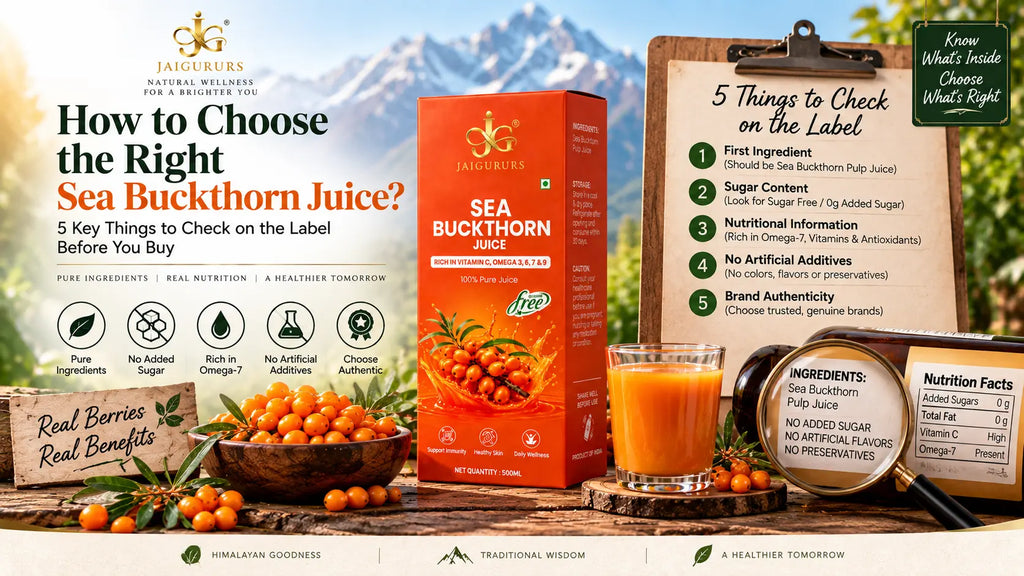
When you search for the best sea buckthorn juice in India, comparing bottles can be surprisingly confusing.
Prices can vary widely, and two products labelled "sea buckthorn juice" may have very different ingredient lists, concentration, processing methods, serving sizes and storage requirements.
So how do you decide which one is worth buying?
The safest approach is to judge the label and formulation rather than the bottle design or marketing claims. If you are looking for pure sea buckthorn juice for a regular wellness routine, these five checks can help you compare products more objectively.
1. Check the Ingredient List: What Is Actually in the Bottle?
The ingredient list is one of the first places to look when comparing sea buckthorn juice. Ingredients are generally listed in descending order by weight under packaged-food labelling rules, so the list can tell you what makes up most of the product.
Look for a clearly stated sea buckthorn ingredient and check whether the product also contains water, other fruit juices, sugar, syrups, flavourings or other additives.
- What to look for: A clearly identified sea buckthorn pulp or juice as the main fruit ingredient, with the formulation explained transparently.
- What to question: Products where water, another fruit juice or a sweetener appears prominently, especially if you are specifically looking for a concentrated sea buckthorn product.
- Important: "100% juice" and "pure" should not be assumed from the front label alone. Read the complete ingredient declaration.
For example, the JaiGururs Sea Buckthorn Juice product is positioned as a pure sea buckthorn pulp juice. Always check the current product label and ingredient panel for the formulation you are purchasing.
2. Check Added Sugar: Don't Confuse Sweetness With Quality
Sea buckthorn has a naturally tart and acidic flavour, so some juice products are formulated with sweeteners or other fruit ingredients to make them easier to drink.
If your goal is to choose a pure sea buckthorn juice, check both the ingredient list and the nutrition information rather than relying only on a "natural" or "wellness" claim on the front of the bottle.
- Check for: Added sugar, sugar syrup, honey, concentrated fruit juice or other sweetening ingredients.
- Compare: Total sugars and added sugars where the nutrition panel provides them.
- For a sugar-free product: Confirm the claim against the current nutrition and ingredient information.
Pure sea buckthorn juice can taste quite sharp. If you prefer a milder flavour, dilute the measured serving according to the product directions. If you choose to add honey or another sweetener at home, remember that it changes the nutritional profile of the drink.
3. Understand the Processing Method: Cold-Pressed Is a Useful Detail, Not a Guarantee
Processing can affect the composition, flavour and shelf life of fruit products. Sea buckthorn is naturally rich in compounds such as vitamin C, carotenoids and fatty acids, but the final nutrient profile depends on the raw material and processing method.
If a brand states that its juice is cold-pressed or cold-extracted, treat that as useful product information—but don't assume that cold-pressed automatically means every nutrient is preserved or that the product is superior in every respect.
- Look for: A clearly described extraction or processing method.
- Also check: Whether the manufacturer explains filtration, concentration, pasteurisation or other processing steps.
- Don't rely on one claim: Combine processing information with the ingredient list, nutrition panel, sourcing and storage instructions.
JaiGururs describes its Sea Buckthorn Juice as a cold-extracted sea buckthorn pulp juice. For the latest processing and product information, use the current product page and label as the reference.
4. Check the Berry Origin and Traceability
Sea buckthorn grows across parts of Asia and Europe, including Himalayan regions. If a brand highlights a particular region such as Ladakh, look for clear sourcing information rather than assuming that a Himalayan image on the packaging proves origin.
Useful questions to ask include:
- Does the brand clearly state where the berries are sourced?
- Does the product provide batch, manufacturer and traceability information?
- If the product claims wild-harvested or high-altitude sourcing, is that claim explained?
- Can the company provide consistent information about its raw material and processing?
Origin matters, but it should be considered alongside the actual formulation. A product's geographic story should never replace a transparent ingredient list and reliable labelling.
5. Look at Texture, Separation and Storage Instructions
Sea buckthorn pulp juice can naturally contain suspended fruit material and oil components. Depending on the formulation and processing, some products may therefore look cloudy or show natural separation after standing.
Natural separation by itself is not a reliable quality test. A clear juice is not automatically inferior, and an oil layer is not automatically proof that a product is authentic. Filtration, concentration and formulation can all change appearance.
- Follow the label: If the product says to shake before use, shake it before measuring the serving.
- Check storage: Follow the manufacturer's refrigeration and after-opening instructions.
- Inspect the product: Unexpected swelling, leakage, mould, an unusual fermented smell or other signs of spoilage are reasons not to consume it.
Most importantly, don't use colour, thickness or an "oil ring" as a standalone authenticity test. The label, manufacturer information and product instructions are more dependable.
Quick Comparison: What to Check Before Buying Sea Buckthorn Juice
| Check | What to Look For | Why It Matters |
|---|---|---|
| Ingredients | Clearly identified sea buckthorn juice or pulp | Shows what the product is actually made from |
| Added Sugar | Check added sugars and sweetening ingredients | Helps distinguish unsweetened products from sweetened blends |
| Processing | Cold-pressed/cold-extracted or other clearly stated method | Provides context about how the juice was produced |
| Origin | Clear sourcing and traceability information | Makes geographic claims easier to evaluate |
| Storage | Clear unopened and after-opening instructions | Helps maintain product quality and safety |
| Serving Size | A clearly stated serving and preparation method | Makes different products easier to compare |
How to Compare Serving Sizes Without Getting Misled
One common mistake is comparing two bottles by their stated serving size alone. A 5 ml serving and a 30 ml serving do not necessarily mean one product is more concentrated or better than the other.
Before comparing prices, check:
- Bottle size in millilitres.
- Ingredients and whether the product is a juice, pulp, concentrate or blend.
- Serving size and number of servings per bottle.
- Added sugar and other ingredients.
- Processing and storage requirements.
For JaiGururs Sea Buckthorn Juice, the product guidance currently specifies 5 ml mixed with 100 ml of water per serving. Always use the serving direction printed on the current product label because formulations and recommendations can change.
Why Does Sea Buckthorn Juice Price Vary So Much?
A higher or lower price does not automatically tell you whether a sea buckthorn juice is better. Price can be affected by fruit sourcing, concentration, bottle size, processing, packaging, logistics and production scale.
If you are comparing the best sea buckthorn juice in India, compare the formulation and quantity first, then compare the price. A cheaper bottle may have a different serving size or a more diluted formulation, while a premium bottle may reflect different sourcing or processing costs.
For current JaiGururs pricing and product details, see the Sea Buckthorn Juice product page.
How to Get Started With Sea Buckthorn Juice
Once you have selected a product, follow its current label directions rather than copying another brand's serving size.
If you are using JaiGururs Sea Buckthorn Juice, the current product guidance is 5 ml diluted in 100 ml of water per serving. For a detailed guide covering preparation, timing and daily use, read How to Use Sea Buckthorn Juice: Daily Dosage, Best Time & Practical Guide.
You can also read our detailed Sea Buckthorn Juice Dosage: 3-Month Routine & How to Take It guide if you are planning a longer-term routine.
Summary Checklist Before You Order
Before buying sea buckthorn juice online, take two minutes to check:
- Ingredients: What is the main ingredient, and is it clearly identified?
- Sugar: Are there added sugars, syrups or other sweeteners?
- Processing: Is the extraction or processing method clearly explained?
- Sourcing: Does the brand provide credible information about berry origin and traceability?
- Storage & serving: Are dosage, preparation and after-opening instructions clear?
- Transparency: Does the manufacturer provide sufficient product and safety information?
The best sea buckthorn juice is not simply the bottle with the highest price or the strongest marketing claims. Look for a transparent formulation, clear labelling, sensible serving information and a manufacturer that explains what is actually inside the bottle.
Frequently Asked Questions
How do I choose the best sea buckthorn juice in India?
Start with the ingredient list and nutrition panel. Then compare added sugar, formulation, processing method, sourcing information, serving size and storage instructions. Don't judge quality from price, colour or packaging alone.
Is pure sea buckthorn juice better than a sea buckthorn blend?
It depends on what you want from the product. If you specifically want a sea buckthorn-only product, a clearly labelled pulp juice is easier to evaluate. A blend can also be a legitimate product, but you should check how much sea buckthorn it contains and what other ingredients are included.
Is clear sea buckthorn juice better than thick pulp juice?
Not necessarily. Appearance depends on filtration, concentration and formulation. A clear juice is not automatically poor quality, and a thick or separated juice is not automatically authentic. Use the ingredient list and product information as your primary checks.
Why does sea buckthorn juice cost more than some other fruit juices?
Price can reflect raw-material sourcing, concentration, processing, packaging, logistics and production scale. Compare the bottle size, serving size and formulation before deciding whether a product offers good value.
Why does JaiGururs recommend a 5 ml serving?
The serving size is specific to the current JaiGururs Sea Buckthorn Juice product guidance. The current direction is 5 ml diluted in 100 ml of water per serving. Serving sizes vary between products, so follow the label of the product you are using rather than comparing millilitres alone.
How can I tell if sea buckthorn juice has gone bad?
Follow the product's storage and use-by instructions. Do not consume a product showing obvious spoilage such as mould, unusual swelling, leakage or an unexpected fermented/off odour. Natural separation is not, by itself, proof of spoilage.
Can I add honey to sea buckthorn juice?
Yes, if you prefer a sweeter taste and the product directions allow dilution or mixing. Remember that honey adds sugar and calories to the drink. If you want an unsweetened routine, keep the measured serving free of added sweeteners.


